Defining Non-Fungibility
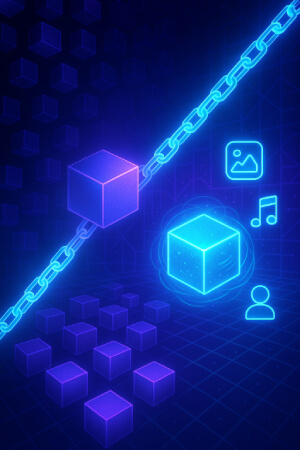
Before getting into an explanation about how NFTs work, one should understand the term "non-fungible." Basically, the term describes something that cannot be switched for another item having exactly the same value. In contrast to an ordinary mundane five-pound note that is fungible in that you can trade it for any other five-pound note and it's the same, a painting, an old concert ticket, or a handwritten letter is non-fungible, possessing in some measure that together whole uniqueness in either history or characteristics.
In terms of digital items, cryptocurrencies like Bitcoin or Ethereum are fungible as each token is the same in value and function. Yet, Non-Fungible Tokens are digital assets that are not interchangeable. They carry individual identities encoded within them, making every NFT different. In contrast, memecoins remain fungible but usually give voice to the cultural aspect of NFTs by staking their claim to shared symbolic value in the name of Internet humor and community identity.
The Role of Uniqueness in the Digital World
Digital files are realities of matter, such as points, images, or videos, being copied endlessly without quality deterioration. Until the arrival of NFTs, no real way existed to establish ownership of the original version of an existing digital work. Thus, in that way, NFT limited the digital scarcity insofar as ownership was linked with a record on the blockchain, which record cannot be easily changed or replicated. It therefore creates one verifiable "original" in an environment where everything else can be endlessly copied.
Why Non-Fungibility Matters
It must not matter for non-fungibility because it puts individuality into the digital value. With NFT, ownership is not just about having a copy of a file but about having a valid claim to that particular tokenized version of it. Such a notion, therefore, stretches way beyond art and into areas like gaming, identity management, certifications, and maybe even legal contracts. Much like memecoins, NFTs highlight the power of internet communities to turn distant or goofy digital assets into tradeable manifestations of culture.
How NFTs Differ from Cryptocurrencies
NFTs and cryptocurrencies originate from the same technologies but serve two completely different purposes. Both use blockchain technology, which works as a decentralized ledger to record and verify the transactions; however, what sets the two apart is the type of data stored and the real-world meaning of the data.
While cryptocurrencies represent units of value or money, NFTs are designed to indicate ownership of a unique item. One Bitcoin is exchangeable for another, the same thing cannot be said for NFTs; you cannot swap one NFT for another and expect equivalence.
Structure and Standards
Most NFTs are minted according to standards of certain blockchains, usually Ethereum ERC-721 or ERC-1155. These specify how NFTs behave and interact within the blockchain ecosystem. They allow each token to carry metadata that defines their characteristics and provenance.
ERC-1155 is more flexible for creators who deal with both unique and uniform digital items, e.g., it allows fungible and non-fungible assets to exist under one single smart contract. These technical standards also enable an NFT to work on a variety of marketplaces and be compatible with any wallets and platforms supporting them.
Economic and Functional Differences
From the economic point of view, cryptocurrencies act as a medium of exchange or store of value. NFTs tend to act as an issue of authenticity or ownership. They do not inherently have any worth attached to them; they gain value based on what they represent and how much people are willing to pay for them. So, in a way, a person owning an NFT is, more or less, like holding a collectible or limited edition item, not the currency. Memecoins demonstrate that token value can be influenced by collective sentiment and humor, even in the absence of real utility or uniqueness.
How Does NFTs Work
The fundamental concept of NFTs concerns digital records on a blockchain. Each contains identification details, metadata, transaction history, and eventually ownership information that separates it from other tokens. So, when you hear the word "minting" an NFT, it refers to the creation of this unique digital token and its permanent recording on a blockchain.
Minting is the process whereby digital content becomes an asset verified on the blockchain. Once minted, an NFT can be kept in any digital wallet or sent to other parties or even sold by means of NFT marketplaces.
The Minting Process
The first stage in minting is to get the digital file, be it a picture, song, video, document, or any other piece of content. The creator uploads it onto an NFT platform that creates an appropriate token for the file on a blockchain such as Ethereum, Polygon, or Solana. The token is linked with the digital asset via metadata and a smart contract.
A smart contract is a program that sets the attributes of an NFT: ownership rights, royalty configurations, transfer rules, and some other considerations. After the token is minted, it gets recorded on the blockchain forever, with full transparency on when it came into being.
Transaction and Verification
The moment any exchange takes place in an NFT, be it a sale, a gift, or barter, the entire transaction gets logged on the blockchain. This includes timestamps, wallet addresses, and transaction IDs, making it easy for one to quell questions of the current proprietorship of an NFT and who owned it previously. With blockchains being public and distributed across the globe, one can independently authenticate and trace the provenance of an NFT without placing reliance on third-party mediations.
Understanding Metadata
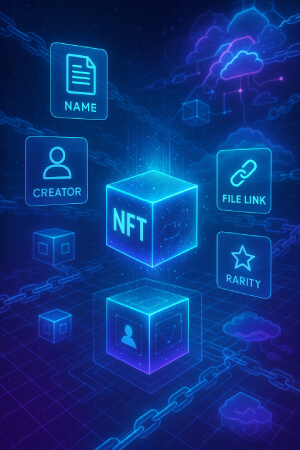
Metadata gives an NFT a special identity. It specifies the characteristics of the NFT, such as name, description, creator, and a link to the associated digital file. In some cases, such as in collectibles or gaming assets, technical attributes in the metadata could make the asset rare or give it some special traits.
Without any metadata attached, NFTs would be mere empty tokens drifting aimlessly on a blockchain. Metadata allows them to act as meaningful representations for digital objects.
On-Chain vs. Off-Chain Storage
Another crucial distinction involves the actual content, meaning the storage of the digital file itself, for an NFT. Most NFTs store the main file off-chain somewhere, either on servers or in decentralized file systems such as IPFS-Universe (InterPlanetary File System). The blockchain holds only a reference link to the file along with its metadata.
Some projects experiment with on-chain storage, putting every data point directly into the blockchain. More permanence is guaranteed, but bearing in mind the data-size limits and transaction fees, the cost may rise steeply. The practical way outIn most cases is the hybrid model, while blockchain records ensue in the off-chain file.
Why Metadata Matters for Long-Term Value
Metadata's integrity and accessibility determine an NFT's long-term and value reliability. If the link off-chain expires or the host server goes away, then, in a way, the NFT loses access to the content it represents. That is why decentralized storage and clear metadata standards are crucial to securing the sustainability of NFTs as a valid form of ownership.
Ownership and Provenance
NFTs do not necessarily give you copyright or legal ownership of the content that lies under. Then, what they do is prove possession of such a tokenized version of it. This subtle difference sometimes causes confusion. Buying an NFT does not mean you have the right to reproduce, distribute, or modify the content: what you own is this particular token on the blockchain.
This ownership has been likened to an ownership of a signed limited edition print. You own the print itself but do not own the intellectual property of the image. What separates an NFT from this is that the pertinent record of every transaction is transparent and traceable, ensuring that the provenance is verifiable.
Provenance as Digital History
Traditionally, provenance, a chain of ownership, is significant. NFTs automate this by embedding provenance into the blockchain. Anybody could therefore track the token's full history, from when it was created to the current holder. Such transparency mitigates the risk of forgery or deception. NFTs thus offer a large venue of trust space to collectors and creators, and this market does not depend on a central governing body.
Smart Contracts and Royalties
Smart contracts may be programmed so that the creator receives a royalty payment from future sales automatically. Upon the reselling of an NFT, the contract facilitates disbursing some funds to the original creator. This has been a game-changer for artists and musicians, allowing them forever to have some say in the pore over their creation.
Use Cases Beyond Art
Although NFTs initially blossomed in digital art and collectibles, their potential applications stretch far beyond the known ones. The same technology could be used for ticketing, issuing certificates, deeds of ownership for lands, in-game assets, or even digital identities.
Basically, NFTs, by providing unique identifiers to items and registering them onto blockchains, create a hole-proof method of authenticating anything in a field where ownership is precisely verified.
Gaming and Virtual Assets
Within the scope of gaming NFTs could be the characters, skins, or items that are genuinely owned and traded by the players without the involvement of the developer. These sort of assets are not supposed to be controlled by a developer in the conventional gaming ecosystem. Using NFTs, the gaming ecosystem could open up possibilities for player-driven economies and interoperability between platforms.
Digital Identity and Certification
NFTs are also being considered for credentials and identity verification. Diplomas, licenses, and professional certificates could be issued as NFTs, handy as tamper-proof against instant and easy verification. Old school manual printing of event tickets to membership passes can now be done through NFT to prevent replication or forgery and guarantee authenticity with direct ownership.
NFTs as Lasting Infrastructure
In the digital age, the NFTs usher in a brand-new take on ownership. Filipino scorn often marks digital goods with abundance, and scarce artists present all manner of conflicting terms. An NFT offers a transparent and permanent medium for verifications, in a mostly duplicable world. The speculative phase generated hype, and with excess after it, but the backbone technology will remain useful for establishing an identity for digital property and managing that identity.
With this maturity of the digital economy, the NFT might silently underwrite multiple models of digital exchange, identity, and creativity-a far cry from the hype of their early days.
Learn More
TOP #NFT PROJECTS BY SOCIAL ACTIVITY$LINK $ICP $PENGU $APE $XTZ $GALA $FET $SUSHI $ROSE $RARE pic.twitter.com/dnicQSrWHX
— PHOENIX - Crypto News & Analytics (@pnxgrp) November 9, 2025
I think no one’s touching grass lately, Wallchain community still grinding hard.@spaace_io just claimed Top 1 on global mindshare.
— MBE (@mbexbt) November 9, 2025
Thought NFTs were dead… or is NFT szn coming back soon? 🧑🍳 pic.twitter.com/3qWjlj9ZIK